
 Equipment


 Music
Music







































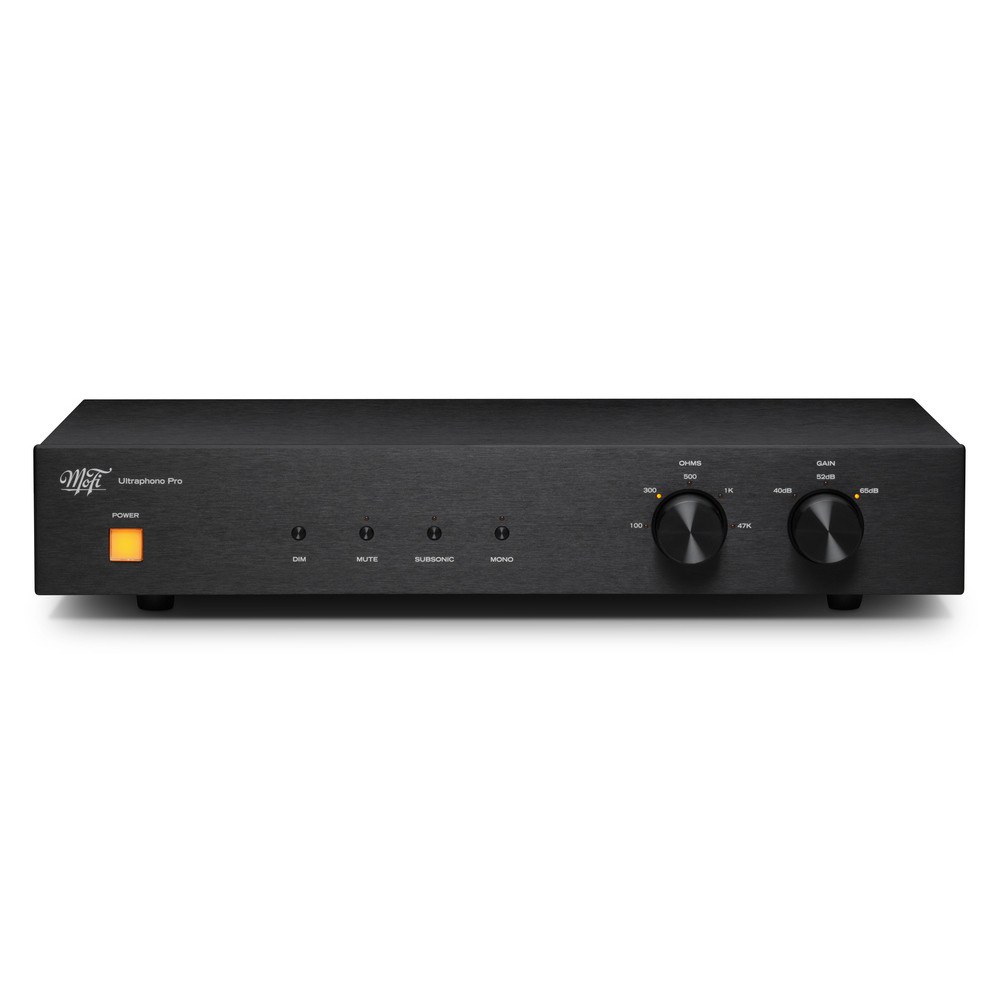

MoFi Electronics UltraPhono Pro MM/MC Phono Preamplifier


Full Details
Get Serious with a Streamlined MM/MC Phono Preamplifier That Stays Faithful to the Source: MoFi Electronics UltraPhono Pro Offers Superb Musicality and Ease of Use, Features Passive RIAA Equalization and Discrete J-FET and MOSFET Stages
Want studio-caliber analog performance without the larger costs that accompany such pursuits? Ideal for turntable enthusiasts who need only a single input, the MoFi Electronics UltraPhono Pro MM/MC phono preamplifier delivers just that and replicates nearly all of the architecture found in its more expensive, multiple-input MasterPhono sibling. Adhering to the very same low-noise topology and hand-selected parts assembly, this U.S.-made component offers superb musicality, precision, and ease of use.
Designed to follow the philosophy embraced by Mobile Fidelity Sound Lab engineers — specifically, to get as close to the original studio sound of a record as possible, refrain from any sort of embellishment, and keep loss to an absolute minimum — UltraPhono Pro strives to extract copious amounts of information from your turntable, tonearm, and cartridge combination, and pass signals along exceptional clarity, integrity, and truthfulness.
That’s why UltraPhono Pro features fully discrete J-FET and MOSFET input and output stages, a seven-stage regulated balanced power supply for an ultra-quiet foundation, and passive RIAA equalization with zero feedback. The latter is a deliberate choice that favors natural transients, tonal realism, organic character, and lifelike presentations. Other audiophile touches — film-foil capacitors that maintain RIAA accuracy within +/-0.05dB to hermetically sealed gold-on-gold relays — further speak to its achieved goals of purist-based analog playback.
Housed in a rigid steel chassis with a brushed aluminum top and front panel, UltraPhono Pro also makes listeners’ lives easy when it comes to cartridge matching and flexibility. All gain and loading controls are accessible via the front panel. And you have options. Three RCA gain settings and three balanced XLR gain settings complement five loading settings. All that, and on-the-fly adjustability, without the needless complexity of a multi-input design.
When paired with other serious-minded audio gear, UltraPhono Pro lives up to its name and renowned designer Peter Madnick’s vision for premium, uncomplicated listening experiences. To learn more, give us a call at 312-433-0200.
Highlights
- Standard signal input via RCA
- Five-position loading adjustment
- Fully discrete from input to output
- Single-ended RCA and balanced XLR outputs
- Switchable gain (40db/52db/65db)
- Passive RIAA with NOS polystyrene and polypropylene film/foil capacitors for better than 1% precision
- All critical resistors are 0.1% or 0.5% tolerance for precise filtering and voltages
- Stereo and mono modes
- Subsonic filter
- Ultra-low-hum field power supply
- Isolated chassis and signal grounding post for low-overall system noise
- Cascaded voltage-regulation stages for lowest noise
Downloads
 User Manual (PDF, 1.0 MB)
Specifications
- Inputs: RCA jack, voltage mode, single-ended
- Loading: Resistive set via front-panel knob
- Ohms Options: 100 Ohms, 300 Ohms, 500 Ohms, 1k Ohms, 47k Ohms
- Gain: RCA output: 40db, 52db, 65db; Balanced output: 46db, 58db, 71db Set via front-panel knob
- Output Impedance: Balanced: 230 Ohms, Unbalanced: 115 Ohms
- Maximum Output: Maximum Output @1% THD, 10 Volts RMS
- THD: 110mV@1kHz 40db gain: 0.005% A-Weighted; 10mV@1kHz 65db gain: 0.005% A-Weighted; 1mV@1kHz 40db gain: 0.010% A-Weighted; 1mV@1kHz 65db gain: 0.013% A-Weighted
- RIAA Accuracy: +/- 0.05db
- Frequency Response: 10Hz – 50kHz +/- 0.20db
- S/N ratio: (20Hz-20KHz) Balanced 40db gain: 82db, 93db A-Weighted; Balanced 65db gain: 78db, 85db A-Weighted; RCA 40db gain: 75db, 83db A-Weighted;
- RCA 65db gain: 69db, 75db A-Weighted
- Chassis size: 17"W x 2.0"H (no feet, 2.5"w/feet) x 9.875"D (chassis only) 11.375" (w/ knobs and jacks)
- Weight: 7lbs.
- AC Mains: 100VAC – 260VAC, auto switching

